Markets Move First, News Follows

Market Recap for the Week of April 13, 2026
Last week delivered another strong showing for equities, an important reminder that markets rarely wait for clarity. Oil prices declined sharply after Iran signaled a reopening of the Strait of Hormuz, easing one of the key geopolitical concerns. Meanwhile, since bottoming on March 30, equities have rallied in nearly a straight line. The S&P 500 has gained approximately 12% over that period, with emerging market stocks advancing even more, up roughly 16%.
This rebound likely caught many investors off guard, particularly those expecting further downside amid recent uncertainty. It reinforces a core principle of investing: markets are inherently difficult to time. Periods that feel most uncertain often coincide with turning points. For that reason, we continue to emphasize the importance of maintaining a disciplined asset allocation aligned with your long-term goals, rather than reacting to short-term market narratives.
That said, some economic aftereffects from recent geopolitical tensions are still likely. Inflation, which already showed signs of firming in March, may remain elevated in the near term. However, markets are forward-looking by nature. Prices today reflect expectations for the next 6–12 months, not current conditions. This dynamic is another reason why waiting for “things to settle down” before investing can be counterproductive; by the time clarity emerges, markets have often already moved.
Looking ahead, investors appear focused on several supportive factors: moderating inflation over time, resilient corporate earnings, and the impact of anticipated fiscal stimulus—particularly through newly enacted tax cuts. Together, these elements are contributing to a constructive backdrop for risk assets.
“Markets rarely wait for clarity—by the time it arrives, the opportunity is often gone.”
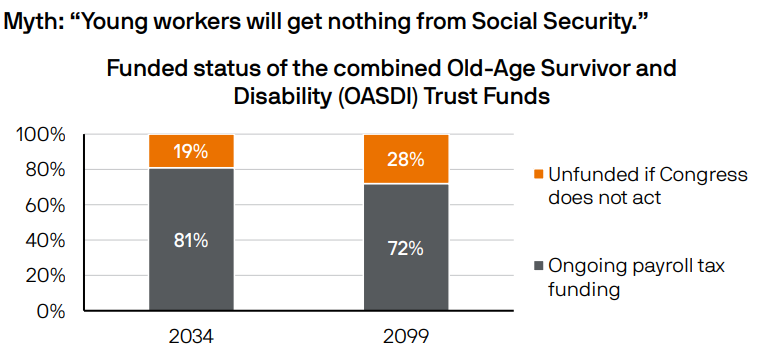
Chart of The Week
This week’s chart, sourced from the JPMorgan Guide to Retirement, addresses a common concern: the long-term viability of Social Security.
While it is true that adjustments are needed to ensure the system’s sustainability, the situation is often misunderstood. If no changes are made, projections indicate that by 2034, benefits would be underfunded by approximately 19%. Importantly, this does not mean Social Security would disappear—rather, benefits would likely be reduced to align with available funding.
In reality, a more probable outcome is legislative action before that point. Historically, policymakers have addressed Social Security funding challenges, albeit often at the last moment. Future adjustments could include tax increases, benefit modifications, or a combination of both. Politically, raising taxes on higher-income earners remains one of the more viable options, suggesting that this group may bear a disproportionate share of any eventual solution.
The commentary in this blog is for informational purposes only and should not be taken as personalized investment advice
Sources: The Social Security Old Age and Survivor Trust Fund is projected to be depleted in 2033, but when combined with the Disability Trust Fund, the projected depletion date is 2034. This material should be regarded as general information and is not intended to provide advice. If you have questions, contact the Social Security Administration and/or your legal or tax professional. Source: (Top chart) 2025 Social Security Trustees Report