Markets Pull Back While Economic Signals Remain Solid

Market Recap for the Week of February 9, 2026
Market Recap
Technology stocks and other large-cap growth names continued to face pressure last week. The broader market, as measured by the S&P 500, declined just over 1% for the week.
Bonds, however, provided a notable counterbalance. The Bloomberg U.S. Aggregate Bond Index rose 0.95%, driven by a roughly 15-basis-point decline in the 10-year Treasury yield. As a reminder, when interest rates fall, bond prices rise — which is exactly what we saw.
Economic Data
Two key economic reports were released last week: employment and inflation.
According to the Bureau of Labor Statistics January employment report, the U.S. economy added 130,000 jobs, while the unemployment rate declined by 0.1%. This was a stronger reading than many of the prior months and suggests continued resilience in the labor market.
On the inflation front, the Consumer Price Index (CPI) rose 0.2% in January, bringing the year-over-year increase to 2.4%. Taken together, these data points indicate that the economy remains on solid footing, with steady growth and moderating inflation.
“As equities pulled back, bonds stepped in as a stabilizer — a reminder that different asset classes don’t move in lockstep.”
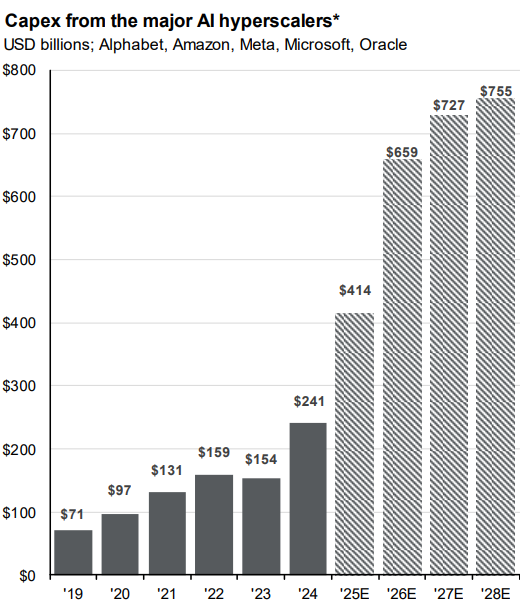
Chart of The Week
This week’s chart highlights the significant capital expenditures being made by large technology companies. Much of this spending is directed toward data centers and infrastructure to support artificial intelligence development.
The critical question is whether these substantial investments will generate attractive returns. History shows that companies often overinvest during periods of technological excitement. While this can benefit the broader economy — accelerating innovation and lowering costs — it does not always translate into strong returns for investors.
Whether these AI-driven capital expenditures will ultimately justify their scale remains to be seen.
The commentary in this blog is for informational purposes only and should not be taken as personalized investment advice
Sources: Bloomberg, J.P. Morgan Asset Management.
Data for 2025, 2026, 2027 and 2028 reflect consensus estimates. Capex shown is company total. Hyperscalers are the large cloud computing companies that own and operate data centers with horizontally linked servers that, along with cooling and data storage capabilities, enable them to house and operate AI workloads.
Guide to the Markets – U.S. Data are as of February 12, 2026.