Legal Limits on Tariffs: Policy Uncertainty Returns to the Forefront

Market Recap for the Week of February 16, 2026
The Supreme Court issued a landmark decision on Friday striking down several tariffs enacted during the Trump administration. The ruling clarified that the President does not have unlimited authority to impose tariffs unilaterally through executive orders. A key unresolved issue is whether more than $100 billion in tariff revenue collected under these measures will need to be refunded.
The decision is unlikely to mark the end of the policy debate. The President has already indicated plans to pursue alternative mechanisms to reinstate tariffs, which will likely face additional legal challenges. As a result, trade policy uncertainty may persist in the months ahead.
On the economic front, fourth-quarter 2025 GDP grew at an annualized rate of 1.4%, bringing full-year growth to 2.2%. While the prolonged government shutdown weighed on fourth-quarter activity, a 2.2% annual growth rate remains a respectable outcome and suggests continued economic resilience.
Equity markets continue to reflect a mixed backdrop. U.S. stocks, as measured by the S&P 500, are up 0.92% year-to-date but remain roughly in line with levels seen at the end of October 2025. In contrast, emerging market equities and small-cap stocks have gained more than 10% over the past three months. Investors concentrated solely in large-cap U.S. equities have experienced a relatively flat period, while more diversified portfolios have benefited from stronger performance in other segments of the market.
“Markets continue to navigate a mixed environment — steady economic growth alongside ongoing policy uncertainty.”
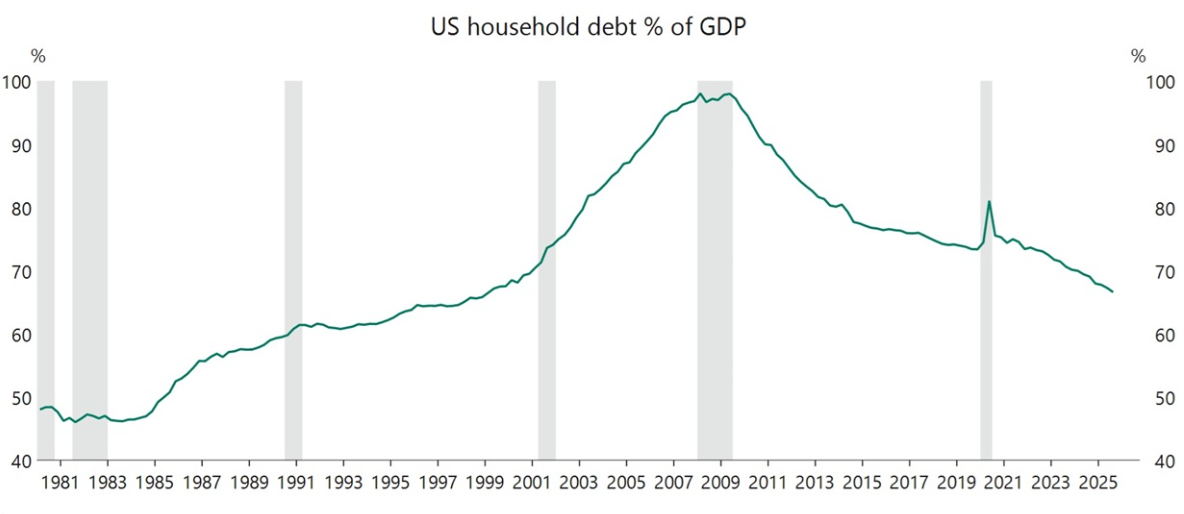
Chart of The Week
This week’s chart, sourced from Apollo Asset Management, highlights U.S. household debt as a percentage of GDP. The data show that following the financial crisis of 2008, households significantly improved their balance sheets and have maintained more disciplined debt levels relative to the size of the economy. This trend supports the underlying health and stability of the U.S. consumer.
In contrast, government debt as a percentage of GDP has moved sharply higher over the same period. While household leverage remains contained, federal borrowing has expanded considerably—an important dynamic to monitor as policymakers navigate future fiscal decisions.
The commentary in this blog is for informational purposes only and should not be taken as personalized investment advice
Sources: Federal Reserve, US Bureau of Economic Analysis (BEA), Macrobond, Apollo Chief Economist