Mixed Signals: Rising Oil, Resilient Stocks

Market Recap for the Week of March 30, 2026
Last week proved challenging for U.S. equities, with weakness concentrated in the mega-cap technology names. The “Magnificent Seven” declined 6.40% on the week, significantly underperforming the broader market, as the S&P 500 fell 3.63%.
Energy markets remained a central driver of sentiment. Oil prices pushed above $100 per barrel by week’s end, dampening earlier expectations for a retreat back toward the $70–$80 range. As the week progressed, it became increasingly clear that elevated energy prices may persist in the near term.
Ongoing geopolitical tensions in Iran continue to underpin this dynamic. While we leave detailed geopolitical forecasting to specialists, the key takeaway for investors is straightforward: the conflict remains unresolved, and energy markets are responding accordingly. Higher oil prices are contributing to renewed inflation concerns and placing pressure on equity valuations.
From a technical perspective, an additional layer of caution has emerged. The S&P 500 recently fell below its 200-day moving average—a widely followed indicator among market participants. While technical analysis should not be relied upon in isolation, it can influence short-term market behavior, particularly as systematic traders and algorithmic strategies react to such signals. This development may contribute to increased volatility or downside pressure in the near term. That said, technical indicators are far from infallible and often generate false signals, reinforcing the importance of maintaining a disciplined, long-term approach.
“Despite rising geopolitical risk, equities are showing resilience as valuations move closer to historical norms.”
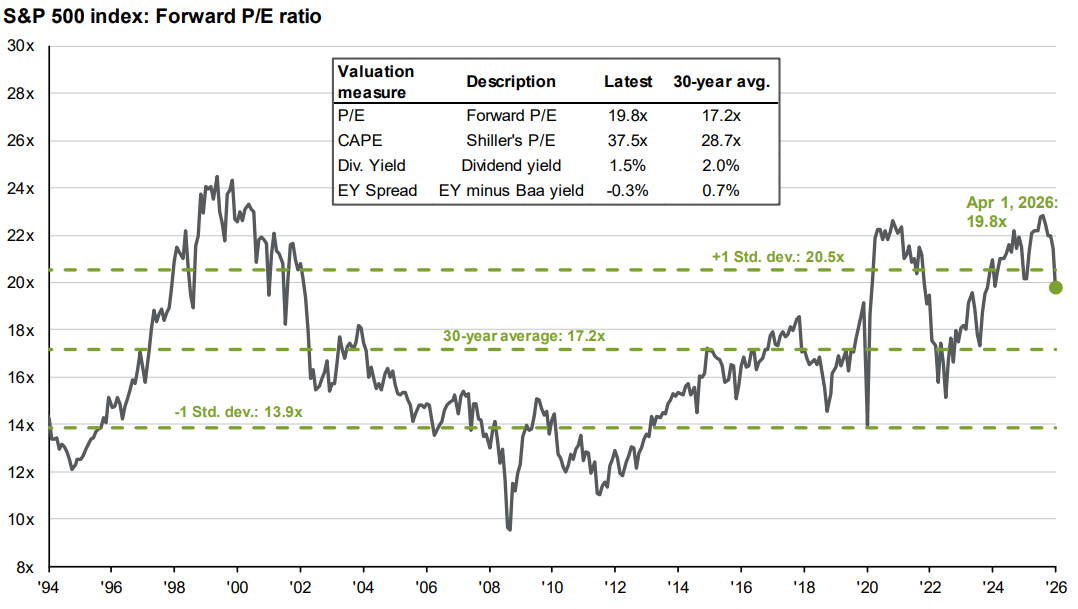
Chart of The Week
This week’s chart highlights the S&P 500’s P/E ratio over the past 30 years. While recent declines have made stocks more attractively priced, they are not necessarily “cheap” by historical standards. It’s also important to recognize that valuation regimes can shift over time. Since the 2020s began, average P/E multiples have been structurally higher than in prior decades, yet equity markets have still delivered solid returns.
While lower valuations can improve long-term return expectations, attempting to time the market based solely on P/E ratios is not a reliable strategy. Staying disciplined and focused on long-term fundamentals remains the more effective approach.
The commentary in this blog is for informational purposes only and should not be taken as personalized investment advice
Sources: Bloomberg, FactSet, Moody’s, Refinitiv Datastream, Robert Shiller, Standard & Poor’s, J.P. Morgan Asset Management.